Cuban Tres, Bass & Guitar - played and recorded with my personal gear
Guides My Setup About Me

Focusrite Scarlett 2i2 vs MOTU M2: Which $199 Interface Wins?

Focusrite Scarlett 2i2 vs MOTU M2: Which $199 Interface Wins?

The Focusrite Scarlett 2i2 4th Gen and MOTU M2 are the two best $199 audio interfaces on the planet — and they take completely different approaches to the same price point.

How Do They Compare?

Focusrite Scarlett 2i2 4th GenMOTU M2
Year20232020
Key FeatureMIDI I/O + Air modeESS DAC + LCD metering
Best ForHome studio, MIDI hardware, streamingAudio quality, headphone monitoring, metering
BrandFocusriteMOTU
Rating4.7/54.6/5
Inputs / Outputs2 in / 2 out2 in / 2 out
Dynamic Range120 dB120 dB
Max Sample Rate192 kHz192 kHz
Max Gain56 dB57 dB
Phantom PowerYesYes
DACStandardESS Sabre32 Ultra
MIDI I/OYesNo
MeteringLED halo ringsFull-color LCD
ChassisMetal + plastic sidesAll metal
Price$199$199

The Quick Answer: Which Should You Buy?

Buy the Scarlett 2i2 if you want the most reliable, best-supported interface on the market with MIDI I/O and Focusrite's legendary build quality. Buy the MOTU M2 if you want the best audio specs and real-time LCD metering — the ESS Sabre32 Ultra DAC is conversion quality you'd normally find in $500+ interfaces. Both cost $199, both are USB-C bus-powered, both have 2 inputs and 2 outputs with loopback for streaming. The Scarlett gives you Air mode (a high-frequency lift inspired by Neve consoles), MIDI I/O, and the most proven driver ecosystem in the industry. The MOTU M2 gives you a full-color LCD screen that shows real-time input and output levels, plus the best DAC in its class. At the same price, you're choosing between features vs specs.
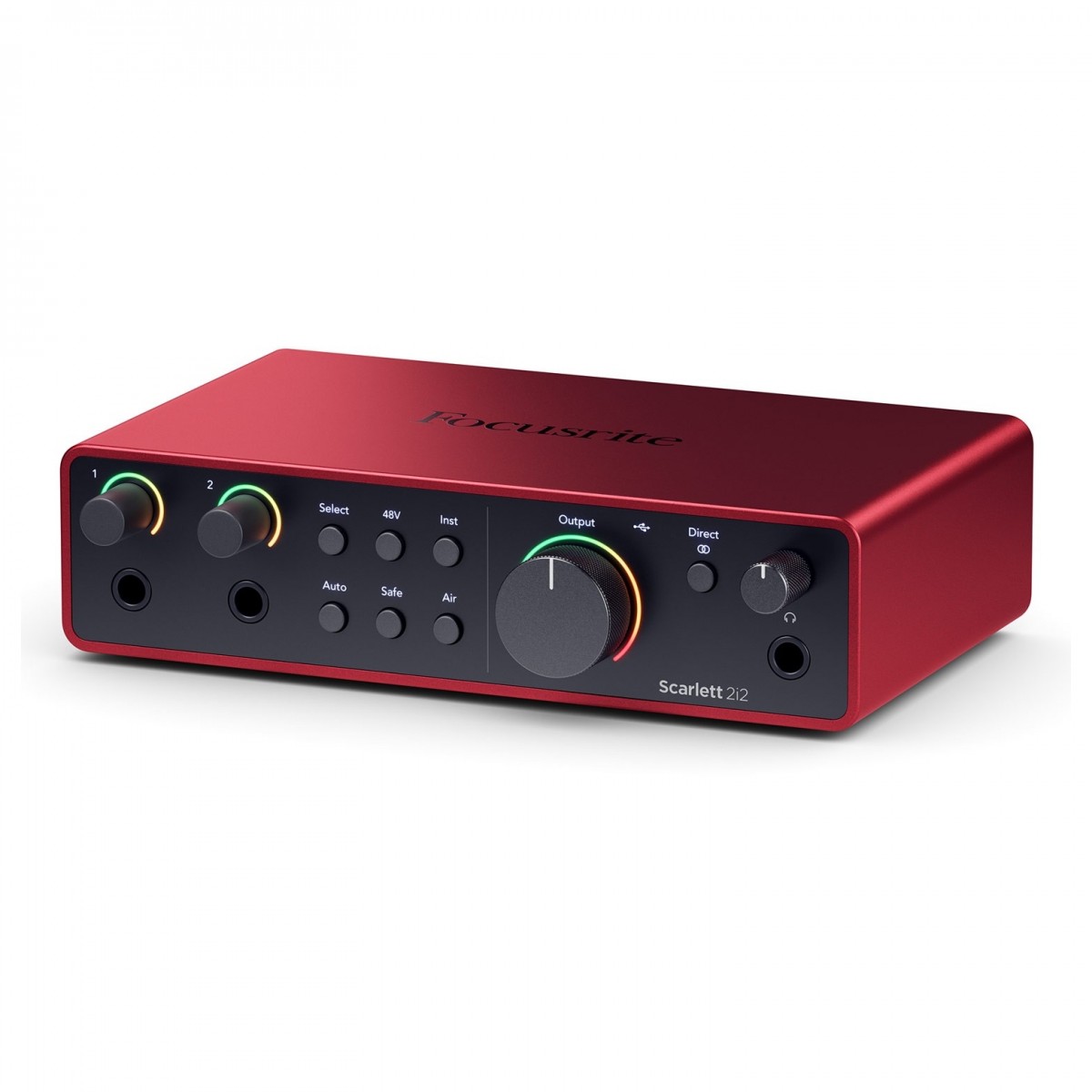

Focusrite Scarlett 2i2 4th Gen

Preamps and Sound Quality: Which Sounds Better?

The Scarlett 2i2's preamps are clean, transparent, and reliable — the 4th Gen delivers 120dB dynamic range with a redesigned analog circuit. The Air mode is the secret weapon: it engages a high-frequency shelf that adds presence and clarity, inspired by vintage Neve console preamps. It's subtle but effective — vocals and acoustic guitars get a lift that helps them sit in the mix without extra EQ.

The MOTU M2 uses ESS Sabre32 Ultra DAC technology — the same conversion found in high-end interfaces from RME and Universal Audio. In blind listening tests, the M2's conversion is measurably cleaner than the Scarlett's, with lower jitter and better stereo imaging. However, the preamps themselves are comparable — both are clean and quiet at this price. Where the M2 truly wins is in the output stage: if you're monitoring through high-quality headphones or speakers, you'll hear more detail and precision.

Focusrite Scarlett 2i2 4th Gen

Metering and Monitoring: The MOTU's Killer Feature

The single biggest differentiator is the MOTU M2's full-color LCD screen. It shows real-time input and output levels with precise numerical readouts — you can see exactly how much headroom you have without guessing. This is invaluable for gain staging: set your input level once and know exactly where you are. No other interface under $300 offers this level of metering.

The Scarlett 2i2 has LED halo rings around the gain knobs that change color — green for good level, yellow for moderate, red for clipping. It's functional and quick to read at a glance, but nowhere near as precise as the MOTU's screen. For direct monitoring, both interfaces offer zero-latency monitoring through the hardware. The Scarlett has a dedicated monitor mix knob; the MOTU uses a software-controlled blend. Both work well, but the Scarlett's physical knob is faster to adjust during a session.

Focusrite Scarlett 2i2 4th Gen

Connectivity and Features: What's On the Back?

The Scarlett 2i2 has MIDI I/O — a significant advantage if you use hardware synthesizers, drum machines, or MIDI controllers. Both interfaces have 2 combo XLR/TRS inputs, 2 balanced TRS outputs, a headphone output, and USB-C. Both are bus-powered. But the Scarlett's MIDI ports mean you can connect a keyboard controller or synth without needing a separate USB MIDI interface. For producers with hardware, this alone can justify the choice.

The MOTU M2 does not have MIDI I/O, but it has a headphone output with its own dedicated DAC and volume control. This means the headphone mix is independent of the main outputs — useful for cue mixes when recording. The M2 also includes loopback on both input pairs, while the Scarlett's loopback is a single stereo mix. For streamers and podcasters, both are equally capable, but the MOTU's loopback routing is more flexible.

Focusrite Scarlett 2i2 4th Gen

Verdict: Which Interface Wins at $199?

Buy the Scarlett 2i2 if: you need MIDI I/O for hardware synths or controllers; you want the most proven, best-supported interface on the market; you value Air mode for instant vocal presence; or you prefer hardware knob control for monitor mixing.

Buy the MOTU M2 if: you want the best audio conversion in the price range; you need precise LCD metering for gain staging; you use high-quality headphones or monitors that benefit from the ESS DAC; or you don't need MIDI I/O.

The honest answer: you can't go wrong with either. At $199, both are exceptional values. The Scarlett is the safer choice — it's been the best-selling interface for a decade because it just works. The MOTU is the spec-sheet winner — better DAC, better metering, but no MIDI. Try both if you can, but know that whatever you choose, you're getting a professional-grade interface that will serve you for years.

Focusrite Scarlett 2i2 4th Gen
Verdict Scarlett 2i2 for features and MIDI, MOTU M2 for DAC specs and metering
Focusrite Scarlett 2i2 4th Gen
Pros
  • MIDI I/O built-in — connect hardware synths, drum machines, and controllers without a separate MIDI interface, saving desk space and money
  • Air mode adds a high-frequency shelf inspired by Neve consoles that gives vocals and acoustic guitars instant presence without plugin EQ — a genuine tonal advantage
  • Hardware monitor mix knob with independent control over input and playback levels — faster to adjust during recording than software-based monitoring
  • 120dB dynamic range with redesigned 4th Gen preamps that are measurably cleaner than previous Scarlett generations, matching interfaces at twice the price
  • Decade-long track record of rock-solid drivers and universal compatibility across Windows, Mac, and iPad — the most battle-tested interface ecosystem available
Cons
  • LED halo metering rings are functional but imprecise — you cannot see exact dB levels or fine-grained headroom information compared to a numeric LCD display
  • Air mode is a single fixed EQ curve — it works well on most sources but cannot be adjusted or disabled per-channel; it's all or nothing on both inputs
  • Loopback is limited to a single stereo mix — less flexible than the MOTU M2's per-pair loopback routing for complex streaming or podcast setups
  • The 4th Gen has plastic side panels rather than full metal construction — lighter but less road-worthy than the M2's all-metal chassis for mobile recording rigs
MOTU M2
Pros
  • ESS Sabre32 Ultra DAC delivers conversion quality typically found in $500+ interfaces — lower jitter, wider dynamic range, and noticeably better stereo imaging and detail retrieval
  • Full-color LCD screen shows real-time input and output levels with numeric precision — the best metering of any interface under $300, invaluable for accurate gain staging
  • Dedicated headphone DAC with independent volume control provides a separate, high-quality monitoring path that doesn't share circuitry with the main outputs
  • All-metal chassis construction feels premium and durable — significantly more road-worthy than plastic-bodied competitors at the same price point
  • Per-pair loopback routing gives streamers and podcasters more flexible audio routing compared to the Scarlett's single stereo loopback mix
Cons
  • No MIDI I/O — connecting hardware synths, controllers, or drum machines requires a separate USB-MIDI interface or direct USB connection, adding cost and cable clutter
  • Monitor mixing is controlled through MOTU's software rather than a hardware knob — less intuitive and slower to adjust during live recording sessions with talent in the room
  • No dedicated instrument input with impedance switching — the combo jacks accept both mic and line but lack the dedicated Hi-Z instrument input found on the Scarlett 2i2
  • Driver ecosystem is smaller and less proven than Focusrite's decade-old platform — while stable, there are fewer community resources and troubleshooting guides available

Frequently Asked Questions

What Products Are in This Guide?

Focusrite Scarlett 2i2 4th Gen

Focusrite Scarlett 2i2 4th Gen

★★★★½ 34,567
$199 USD
The world's best-selling audio interface just got better. 120dB dynamic range, Air mode, and Loopback for streaming. Studio-grade conversion.
MOTU M2

MOTU M2

★★★★½ 4,567
$199 USD
The best value in its class. Full-color LCD metering, ESS Sabre32 Ultra DAC, and loopback for streaming. The only interface under $200 with real-time level monitoring.
SoundBetter Fiverr
Cuban Tres, Bass & Guitar - played and recorded with my personal gear