


Moog One 16-Voice vs Sequential Prophet-10: Best Professional Synthesizers Compared
Analog synthesis at the highest level. The most powerful polyphonic analog synth ever made versus the immortal voice of analog polyphony.
How Do They Compare?
| Moog One 16-Voice | Sequential Prophet-10 | |
|---|---|---|
| Year | 2018 | 2020 |
| Polyphony | 16 voices | 10 voices |
| Timbrality | Tri-timbral (3 parts) | Mono-timbral |
| Oscillators per Voice | 3 triangle-core VCOs | 2 CEM 3340 VCOs |
| Filter | Dual: Moog ladder + state-variable | Single: SSM 2040 or SSI 2140 (switchable) |
| LFOs | 4 per voice | 2 per voice |
| Envelopes | 3 DAHDSR per voice | 2 ADSR per voice |
| Effects | Built-in Eventide (reverb, delay, etc.) | None (external only) |
| Keyboard | 61-key Fatar TP-8S | 61-key Fatar with velocity/aftertouch |
| Rating | 4.8/5 | 4.9/5 |
| Sequencer | Built-in 16-step programmable | Built-in 16-step with motion sequencing |
| Patch Storage | 1,000+ user presets | 200 user presets |
| Weight | ~68 lbs (~30.8 kg) | ~35 lbs (~15.9 kg) |
| Price | $9,999 | $4,399 |
The Contenders
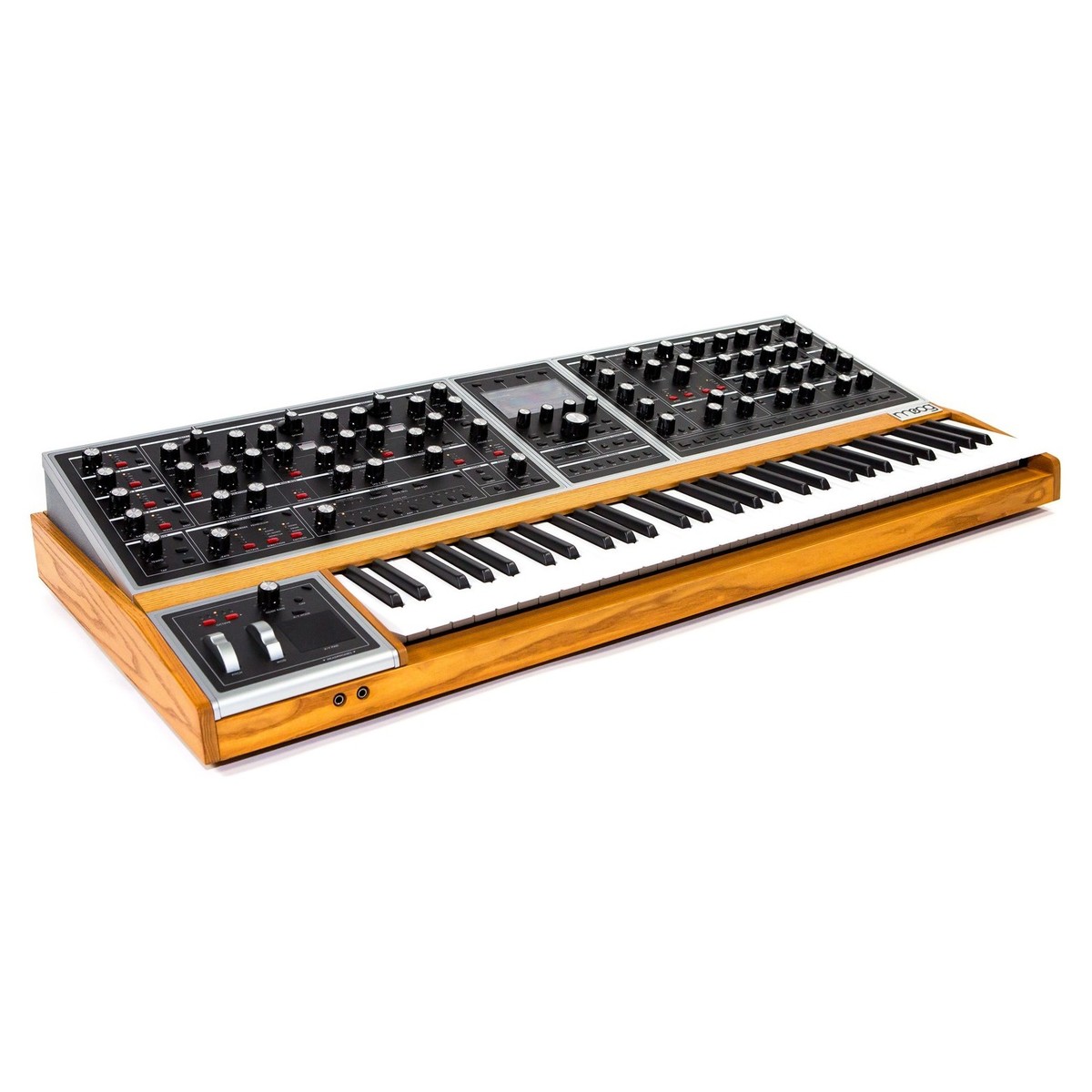
Analog synthesis at the highest level — two completely different philosophies, both equally essential. The Moog One 16-Voice ($9,999) is the most powerful polyphonic analog synth ever made. Three triangle-core VCOs per voice, dual analog filters (Moog ladder + state-variable), Eventide reverbs, and 16 voices of tri-timbral capability. It creates sounds no other synth can touch. The Sequential Prophet-10 ($4,399) is a faithful reissue of the legendary Prophet-5 with double the voices. Two CEM 3340 VCOs per voice, switchable SSM 2040/SSI 2140 filter, poly-mod, and vintage control for oscillator drift. The Moog One is the ultimate sound design instrument; the Prophet-10 is the immortal voice of analog polyphony.
Moog One 16-Voice
Flagship 16-voice tri-timbral analog synthesizer. Three triangle-core VCOs per voice, dual analog filters (Moog ladder + state-variable), 4 LFOs, 3 DAHDSR envelopes per voice, Eventide reverbs, and a 61-key Fatar TP-8S with velocity and aftertouch. The most powerful polyphonic synth Moog has ever made — the ultimate sound design instrument.
Sequential Prophet-10
10-voice polyphonic analog synthesizer faithful to the legendary Prophet-5. Two CEM 3340 VCOs per voice, switchable SSM 2040/SSI 2140 24dB lowpass filter, poly-mod, vintage control for oscillator drift, and a 61-key Fatar keyboard with velocity and aftertouch. 400 presets including 40 original Prophet-5 sounds. The immortal voice of analog polyphony.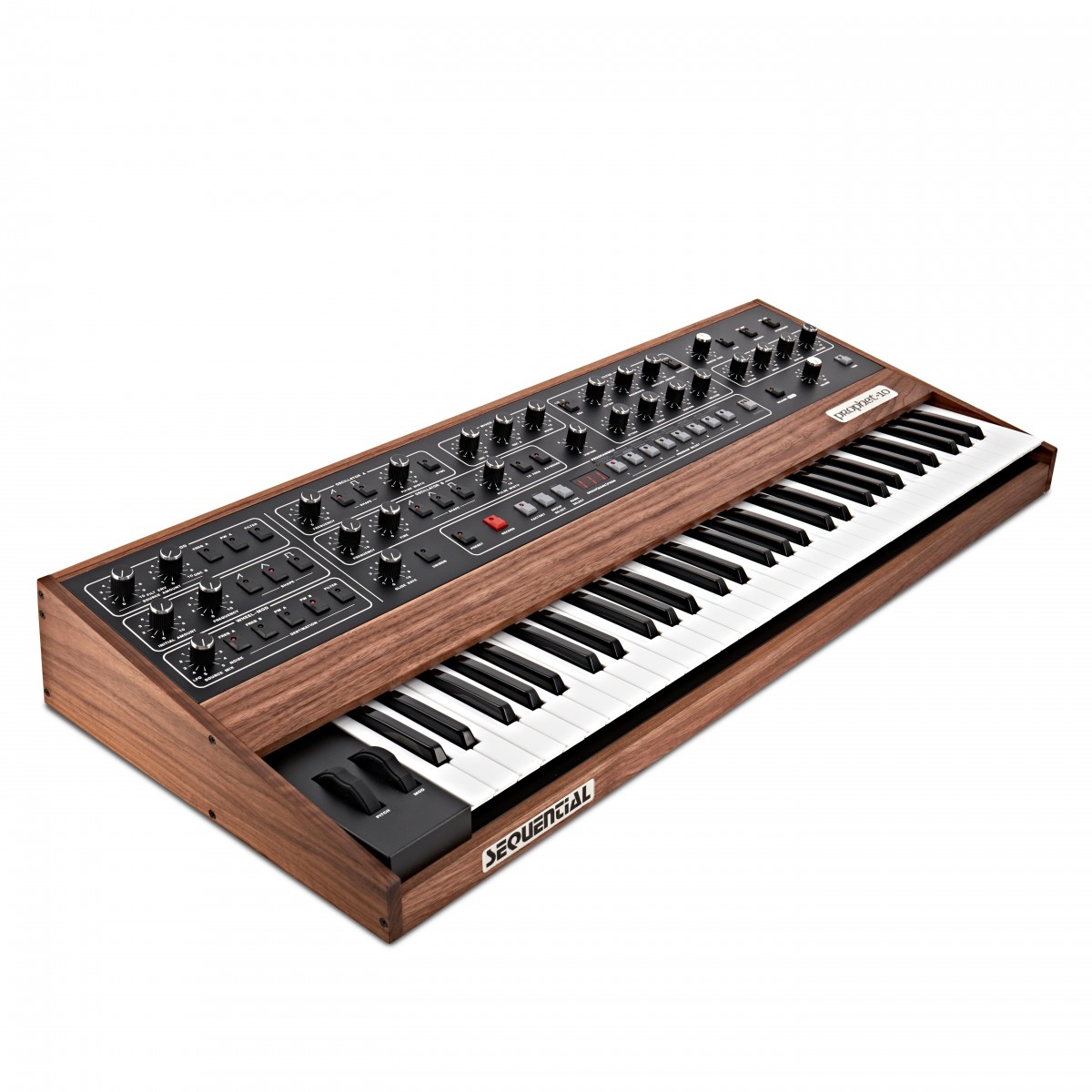
Verdict
Moog One for ultimate sound design; Prophet-10 for classic analog polyphony
Moog One 16-Voice
Pros
- 16 voices of pure analog polyphony — the most powerful Moog ever made
- Tri-timbral: play three independent synth parts simultaneously
- 3 triangle-core VCOs per voice with incredibly fat and warm oscillators
- Dual analog filters (Moog ladder + state-variable) — best of both worlds
- Built-in Eventide reverb and effects — studio-quality without external gear
Cons
- Extremely expensive at $9,999 — the most expensive analog poly synth on the market
- Very heavy and large — not designed for portability or small studios
- Complex architecture can be overwhelming for new synthesizer users
- Limited to 16 voices — voice-hungry patches eat polyphony quickly
Sequential Prophet-10
Pros
- 10-voice true analog polyphony — double the original Prophet-5
- Faithful reissue of the legendary Prophet-5 — the sound that defined 80s music
- Vintage control emulates oscillator drift for that classic analog character
- Switchable filter chips (SSM 2040 vs SSI 2140) for two distinct filter flavors
- More immediate and intuitive programming than the Moog One
Cons
- Only 10 voices vs the Moog One's 16 — fewer notes for complex pads
- Mono-timbral — can only play one sound at a time
- Single filter type per voice (switchable but not dual like the Moog One)
- No built-in studio-quality effects (no Eventide reverbs)
- VCOs are based on CEM 3340 (authentic but less complex than Moog's triangle-core)
Frequently Asked Questions
What Products Are in This Guide?
Moog One 16-Voice
$10.0k USD
Flagship 16-voice tri-timbral analog synthesizer. 3 triangle core VCOs per voice, dual analog filters (Moog ladder + state-variable), 4 LFOs, 3 DAHDSR envelopes per voice, Eventide reverbs, 61-key Fatar TP-8S with velocity and aftertouch. The most powerful polyphonic synth Moog has ever made.


Sequential Prophet-10
$4.4k USD
10-voice polyphonic analog synthesizer. Faithful reissue of the legendary Prophet-5 with double the voices. Features 2 CEM 3340 VCOs per voice, 24dB lowpass filter (switchable between SSM 2040 and SSI 2140 chips), poly-mod, vintage control for oscillator drift, 61-key Fatar keyboard with velocity and aftertouch. 400 presets including 40 original Prophet-5 sounds.
Cuban Tres, Bass & Guitar - played and recorded with my personal gear